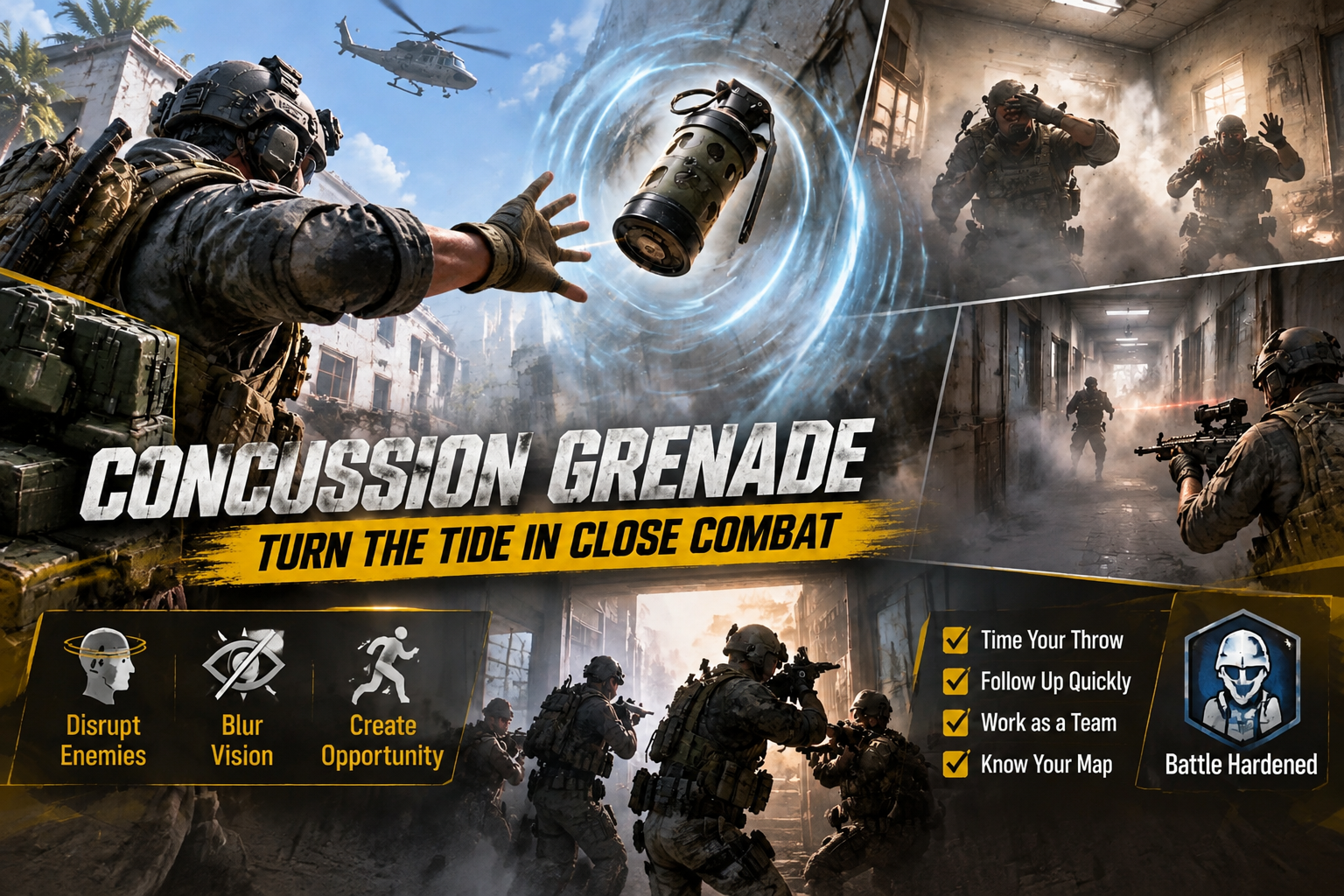
Close-range encounters in Modern Warfare 4 can change direction within seconds, particularly when fighting inside buildings, around tight corners, or along narrow corridors. In these situations, a player’s ability to react quickly and maintain control of their surroundings often determines the outcome of an exchange. Players using Bot Lobby MW4 matches to practice different combat situations can pay particular attention to how tactical equipment affects movement, positioning, and room entry. Among the available options, the Concussion Grenade has a distinct role because it disrupts enemy reactions and blurs their vision, creating opportunities that cannot always be achieved through direct gunfire. Its influence becomes especially noticeable when one team attempts to enter a defended room or challenge opponents holding a narrow approach.
The Concussion Grenade is unlocked at Player Level 15 and is designed to disorient enemies by reducing their reaction speed and impairing their vision. These effects can make it harder for an opponent to track an approaching target or respond accurately when an attack begins. The advantage is particularly relevant in confined spaces, where players have fewer opportunities to retreat or change their position. A moment of disruption may give an attacker enough time to cross a doorway, reach nearby cover, or establish a better firing angle. However, the grenade does not guarantee a successful elimination. Its effectiveness depends on what happens immediately afterward, including the attacker’s positioning, weapon choice, and awareness of other enemies nearby.
Using Concussion Grenades to Control Indoor Engagements
Indoor combat provides some of the clearest examples of how this equipment can influence an engagement. Buildings often contain several entrances, connecting hallways, staircases, and small rooms that limit visibility. A defender holding a doorway may have a strong advantage because incoming players must expose themselves before gaining a clear view of the room. Throwing a Concussion Grenade before entering can interrupt that defensive setup and create a brief opportunity to move forward. The attacking player must still consider whether another opponent is covering the entrance or holding an angle from a nearby room. Rushing immediately after a successful throw without checking these possibilities can turn an apparent advantage into an unfavorable exchange.
Narrow corridors create a different problem because they restrict movement and make positioning more predictable. A defender at the far end can control the approach with sustained fire, while an attacker may have very little room to dodge or find alternative cover. In this situation, the Concussion Grenade can interrupt the defender’s response and give an advancing player a chance to challenge the position. Timing is particularly important. Throwing too early may allow the opponent to recover before the attacker reaches the firing angle, while throwing too late can leave the advancing player exposed before the equipment has any meaningful effect. Players who understand the distance between their throwing position and the target can make more deliberate decisions instead of relying on repeated attempts.
The type of weapon used after the explosion also influences the result. Submachine guns are well suited to aggressive entries because their mobility and close-range handling allow players to challenge opponents quickly after creating an opening. Shotguns can be effective when an engagement takes place inside a particularly small room, although their limited flexibility makes distance management important. Assault rifles offer a more adaptable option when the fight may continue beyond the immediate doorway or extend into a longer corridor. Rather than choosing equipment independently of their primary weapon, players should consider how both choices will work together during the same engagement.
The following comparison shows how the Concussion Grenade can influence different close-range situations and what players should consider before committing to an attack.
| Combat situation | Potential tactical advantage | Important consideration |
|---|---|---|
| Indoor room entry | Disrupts defenders before an assault | Check for additional enemies and alternate entrances |
| Narrow corridor | Interrupts opponents holding a fixed angle | Avoid predictable throwing patterns |
| Staircase engagement | Creates an opportunity to challenge elevated defenders | Account for limited retreat space |
| Objective defense | Disrupts an incoming push and delays attackers | Preserve equipment for important engagements |
| Close-range ambush | Makes an opponent’s immediate response more difficult | Prepare for supporting enemies nearby |
Team Coordination Makes Every Grenade Count
Team coordination becomes especially important when several players are approaching the same defended position. If everyone enters through one doorway without considering their responsibilities, they may obstruct one another or leave another approach completely uncovered. A more organized push allows one teammate to initiate the engagement while another prepares to challenge the affected defenders. A third player can watch the entrance or monitor a secondary route to prevent opponents from repositioning unnoticed. This arrangement makes the grenade part of a coordinated attack rather than an isolated action that depends entirely on individual timing.
Several practical decisions can make these engagements more controlled:
- Read the defensive setup: Pay attention to enemy movement, recent gunfire, and likely firing positions before throwing the grenade.
- Account for the environment: Consider nearby walls, doorways, and available cover when choosing where to deploy the equipment.
- Prepare the follow-up: Coordinate with teammates so that someone is ready to advance when the opportunity appears.
- Change the approach: Avoid repeatedly using the same entrance or throwing from an identical position, as experienced opponents can anticipate these patterns.
- Watch for secondary threats: A disrupted defender may still have teammates covering another angle or protecting the objective.
Defensive Strategies Against Tactical Disruption
Defenders are not without options, and their response can make the difference between losing a position and successfully holding it. Maintaining some distance from frequently used entrances can provide additional room to react when tactical equipment arrives. Moving between defensive angles also makes it harder for attackers to predict exactly where resistance will come from. Instead of relying on a single doorway, teammates can establish overlapping lines of sight and cover different approaches. This arrangement forces incoming players to consider several threats even when one defender is temporarily affected by a grenade.
Perk selection adds another layer to this contest. Battle Hardened is unlocked at Player Level 12 and reduces the effects of enemy tactical equipment, giving defensive players a useful option when facing opponents who frequently rely on grenades to initiate close-range fights. Its value can be particularly noticeable in objective-focused matches where teams repeatedly contest the same rooms, entrances, and narrow routes. However, choosing the perk still involves a broader loadout decision. Players need to consider whether protection against tactical disruption is more valuable than the benefits offered by other available perks. It can improve resistance to tactical pressure, but it does not eliminate the need for good positioning or communication.
Winning the Fight Requires More Than a Successful Throw
The interaction between attackers and defenders therefore depends on more than the grenade itself. Attackers must judge when to disrupt a position, how quickly to follow up, and whether the available route offers enough protection. Defenders need to recognize incoming pressure, avoid predictable positioning, and maintain communication with teammates who can cover exposed angles. Both sides also need to consider whether an apparent push is intended to draw attention away from another entrance. These decisions make tactical equipment an important part of close-range combat, even when its effects do not directly result in an elimination.
The distinction between creating an opening and winning a gunfight is worth remembering. A successful Concussion Grenade does not automatically give the attacking player superior aim, better weapon handling, or protection from another opponent. A delayed entry can allow the defender to recover, while an inaccurate follow-up may waste the brief advantage created by the explosion. Players should use the disruption to improve their position and establish a more favorable angle rather than treating every successful throw as a signal to rush forward. This approach also makes weapon familiarity important, since players must be ready to transition from equipment use to accurate gunfire without losing control of the engagement.
Map awareness supports these decisions throughout a match. Familiarity with common defensive positions helps players identify where a grenade may have the greatest impact, particularly around objective entrances, stairwell landings, and narrow connecting passages. However, experienced opponents rarely remain in one position for an entire match. Changing routes, adjusting defensive spacing, and watching secondary entrances can prevent a familiar tactical setup from becoming predictable. Players who pay attention to how opponents respond to previous attacks can also make better decisions about when to use their remaining equipment.
The wider tactical loadout deserves consideration as well. Flash Grenades, Smoke Grenades, and Snapshot Grenades serve different purposes, so their value depends on the situation rather than a universal ranking. A Flash Grenade can impair an opponent’s ability to see and hear, while smoke can provide visual concealment when crossing exposed ground. A Snapshot Grenade offers temporary information about nearby enemy positions, helping a team prepare for an approach. The Concussion Grenade has a more direct role in disrupting an opponent’s immediate response. Understanding these distinctions allows players to select equipment that complements their preferred combat style instead of carrying a tactical option without a clear purpose.
Turning Tactical Equipment Into a Reliable Advantage
Ultimately, the Concussion Grenade adds another layer of decision-making to Modern Warfare 4’s close-range encounters. Its impact is most apparent when indoor layouts, narrow approaches, and coordinated attacks leave little room for mistakes. Successful players need to understand not only when to throw it, but also how to capitalize on the resulting opportunity and respond when an opponent uses defensive perks to reduce its effects. These principles reflect the importance of preparation across different parts of the game, although multiplayer equipment choices and DMZ progression serve separate purposes. In DMZ, managing resources and understanding the value of MW4 DMZ Cash contribute to preparation before deployment, while multiplayer success depends more directly on positioning, timing, and teamwork. Both modes reward players who understand their available resources and make deliberate decisions rather than relying on a single advantage.