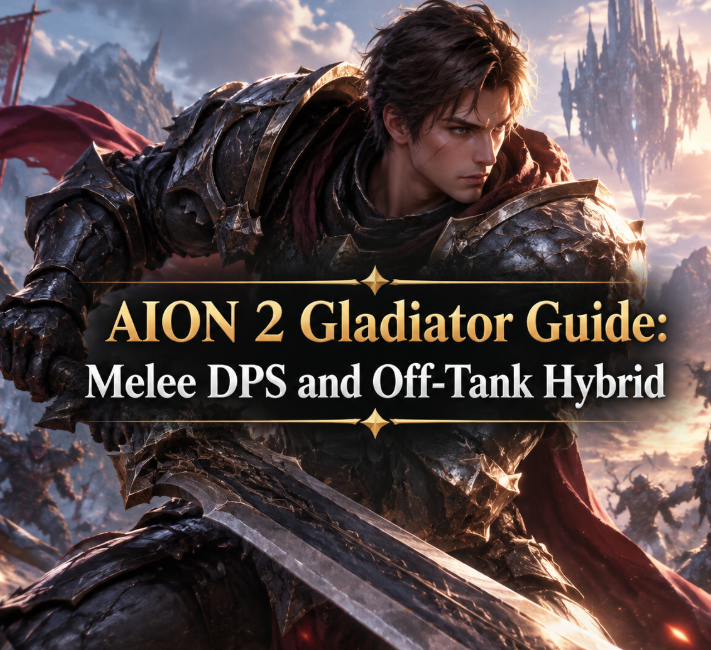
The Gladiator is one of AION 2’s most straightforward frontline classes. Built around a greatsword and heavy armor, it combines sustained melee damage with strong survivability. While the Templar is designed around dedicated tanking, the Gladiator can step into an off-tank role when a group needs additional durability. This makes the class a good choice for players who want to deal damage without feeling overly fragile.
Understanding the Gladiator Role
The Gladiator’s biggest strength is staying in the middle of a fight. Instead of relying on short burst windows, the class uses powerful melee attacks, wide-area strikes, and sustain to keep pressure on enemies. Its large health pool gives it more room to survive mistakes, while its defensive tools allow it to absorb pressure when necessary.
For normal PvE groups, the Gladiator should usually focus on damage first. When the main tank loses control of an enemy or needs help during a dangerous mechanic, the Gladiator can temporarily take pressure off the party. However, this does not mean you should constantly compete with the Templar for threat. A good off-tank knows when to attack aggressively and when to step into a defensive role.
Greatsword Combat and AoE Damage
The greatsword is central to the Gladiator’s playstyle. Many of its attacks can hit multiple enemies, making the class particularly comfortable when fighting groups of monsters. Rending Blow and Keen Strike are useful parts of the basic combat flow, while skills such as Crushing Wave and Blade Dance provide stronger area damage.
When fighting several enemies, avoid focusing entirely on one target unless the encounter requires it. Position yourself so your wide attacks can hit as many enemies as possible while still keeping the group under control.
Single-target encounters require a slightly different approach. Keep your main damage skills cycling instead of waiting too long for the perfect combination. The Gladiator performs best when it maintains steady pressure throughout the fight.
Skill Priority
Your first priority should be the abilities that form your regular damage rotation. Core attacks such as Rending Blow and Keen Strike help establish consistent pressure, while stronger cooldown abilities should be used whenever their timing fits the encounter.
Defensive abilities deserve the next level of attention. Survival Stance, Protection Armor, Focused Block, Defiance, and Armor of Balance give the Gladiator tools for surviving heavy incoming damage. These should not all be activated at once. Learn which attacks are dangerous and save the appropriate cooldown for those moments.
Lifestealing Blade and Blood Absorption are also important because sustain is part of what allows the Gladiator to remain in melee range. They become especially useful during extended encounters where constant damage and recovery matter more than short bursts.
Playing as an Off-Tank
The off-tank role requires more awareness than simply putting on defensive skills. Watch the main tank’s position and enemy health, and be ready to react when an enemy breaks away or a mechanic requires another player to absorb damage.
When you need to take over, establish threat quickly and position the enemy safely. Once the situation is stable, return to your normal damage pattern rather than holding defensive skills indefinitely.
Spending Aion 2 Kinah on balanced upgrades is also important for this hybrid playstyle. Prioritize equipment that keeps your damage competitive while providing enough HP and defensive strength to survive when you temporarily take the role of tank.
Gear and Combat Priorities
A Gladiator should avoid building exclusively for damage if you regularly play as an off-tank. Attack power and offensive stats remain important, but survivability becomes increasingly valuable in difficult group content.
Attack speed can also have a noticeable impact on how the class feels. A faster and smoother combat rhythm makes it easier to maintain pressure and respond to changing situations. If you are still developing your character, upgrade your equipment gradually instead of trying to replace everything at once.
Players looking for cheap Aion 2 Kinah should still keep their spending focused on upgrades that directly improve their build. There is little value in investing heavily in equipment that you will replace shortly afterward.
The Gladiator works best when you think of it as a durable melee fighter rather than a second Templar. Stay close to enemies, make full use of your wide attacks, maintain steady damage, and keep defensive abilities ready for moments when the group needs additional protection.
For solo play, focus on efficient AoE damage and sustain. In groups, prioritize consistent DPS while remaining prepared to take over when necessary. Once you become comfortable switching between offense and defense, the Gladiator becomes a flexible frontline class that can adapt to a wide range of encounters.